Backdrop:
- Whatsapp brought its new privacy policy in January 2021 which required the users of business accounts to accept its policy of sharing the user information with the businesses. A PIL in Delhi HC flagging the breach of Fundamental Right to privacy guaranteed under article 21was filed. Govt of India (Ministry of IT and Electronics)argued against WhatsApp and cited “discriminatory treatment of Indian users”.
- Meanwhile, serious concerns were raised about the Right to Freedom of Speech and expression when the OTT platforms(which didn’t come under any regulatory authority/censor board) emerged as popular means of entertainment in the COVID world.
- Following the rising need for some regulatory framework, the government of India came with the IT intermediary Rules(Intermediary Guidelines and Digital media Ethics Code Rules-2021)on 25 Feb 2021.
- Section IV of Part II of these IT intermediary guidelines have raised serious concern for the Rights of users of various social messaging platforms viz wp. signal etc. Whatsapp filed a case in HC on 25 may, a day before the last date for voluntary acceptance of the rules by the agencies.
- Now the two cases of contrary nature are running parallel in the same court.
- Yet another row recently emerged when twitter failed to comply with the new IT Intermediary laws in due time and the government sacked its Intermediary status in India.
The updated policy of WhatsApp(Jan 2021):
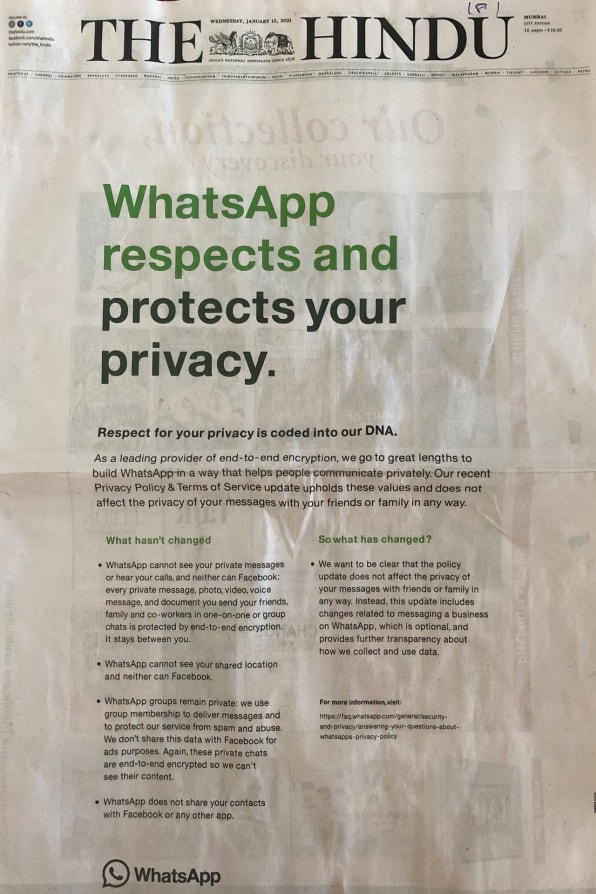
The update in the privacy policy of the messaging app required the user to allow sharing of their data while communicating with the selected businesses within the app, which can in turn use this data for advertising and other communication purposes. However, WhatsApp states this does not break end-to-end encryption for private messages and it does not keep the details of users' calls and texts. End-to-end encryption in private chats means that the information/content shared between the users i.e. in the private chats, won’t be accessible to any third party, not even WhatsApp.

Implications related to this new policy:
CEO Mark Zuckerberg in 2019 emphasised integrating Facebook, Messenger, Instagram and WhatsApp in what he called "interoperability". This was with motivation to improve ad experience across other products of the company. The new policy is an implementation of this vision, i.e., facilitating the integration of WhatsApp data in other products of Facebook.
The Govt. of India accused WhatsApp of being biased against Indian users. Interestingly, these privacy policies are not valid in the European nation for a good reason. Under GDPR(General Data Protection Regulation), WhatsApp is not allowed to share data with Facebook or any other party in the European region. India’s similar data protection law has been pending for more than 2 years now. The government blamed WhatsApp for implementing this policy early when it was aware of the fact that India’s Data Protection law is in progress.
Response of other nations to the new WhatsApp policy:
Other nations such as turkey have also joined in on the backlash against WhatsApp's new policy. The Turkish defence ministry has now completely abandoned WhatsApp.
Whatsapp’s partiality for Europe in its new policy has another interesting aspect.
Europe has a strict privacy protection law, breaking which can lead to a really heavy fine (4% of the annual revenue) may be imposed on the company. When Facebook acquired WhatsApp, the EU was suspicious of Facebook breaching the bloc’s laws on privacy and then Facebook stated that “ it is impossible to combine the functionality of WhatsApp to benefit Facebook”. Hence, the new policy is very different for Europe. That too has now been banned in Germany.
IT Intermediary laws(Part II Section IV ):
Besides this issue of privacy, issues related to the online curated content and OTT platforms attracted concerns, relating to the freedom of expression and its misuse on the digital platforms. Rising demands of some immediate regulatory framework to bring the digital media under vigilance led the Govt to bring a set of intermediary rules.
The govt of India issued the Intermediary guidelines and Digital Media Ethics code rules-2021 on 25 Feb 2021. Some of its provisions are being criticised by the experts. The provision under Section IV contained in Part II of the Gazette requires the messaging applications with over 5 million users to keep track of the true originator of the content. This is colloquially called traceability. If the content is found a threat to the sovereignty, integrity, social order of the country by competent authorities as a part of the investigation, the data of the originator can be shared with the "authorities". Although the data of the people who interacted with the originator will be kept undisclosed.
To be sure, the government is clear on what it wants: to know who sent a particular message on a messaging platform. But it does not specify how that is to be achieved and has left it to the platforms to figure out. It doesn't want to break E2E encryption.

What Technical and legal experts say?
Experts say that enabling traceability without breaking or at least undermining end-to-end encryption will not be possible and undermining encryption for one person will make every other person on these platforms vulnerable.
But to assist the government in law-abiding and punishing the guilty on one hand and maintain the privacy of users on the other, the platforms need some extremely new technology that has not been developed until now. Currently, WhatsApp and other messaging apps do assist law enforcement agencies in investigations, but in some other way. But the problem is since the encrypted messages don’t give access to content shared with any third party, it is nearly impossible to know which content was created or shared by whom. And that gives a safe harbour to criminals in the form of encrypted chats.
Collecting the mobile phones of the suspects and then investigating their personal chats may be a solution but that is something practically not very feasible.
What WhatsApp said in the case filed in the HC?
Whatsapp, in its defence, has questioned the government's stance toward user privacy in the new IT laws since traceability has been asked out of messaging platforms with more than 50 lakh users. Currently, WhatsApp uses end to end message encryption which ensures that only the sender and receiver can view the data being shared.
Furthermore, WhatsApp said that the non-business accounts on its platform will be unchanged by its new privacy policy which will be implemented only on business accounts.
WhatsApp in its challenge in court has argued that breaking encryption could put at-risk groups such as journalists and civil or political activists. “In doing so, a government that chooses to mandate traceability is effectively mandating a new form of mass surveillance. To comply, messaging services would have to keep giant databases of every message you send, or add a permanent identity stamp — like a fingerprint — to private messages with friends, family, colleagues, doctors, and businesses,” it said.
Recent TWITTER row:
As the new laws were enforced in India on May 26 all the social media platforms were to send a compliance report, clearly citing the measures taken to comply.
But American giant Twitter failed to comply and later openly refused to adhere to the laws, inviting the later withdrawal of its intermediary status.
What is the intermediary status and what are the repercussions of its withdrawal?
The recently lost intermediary status was an immunity given to social media platforms by the government; considering the platforms as “hosts” of information being shared on them, thus saving them from any lawsuits filed on its users because of the information shared on the platform.
But now, Twitter will be considered as a publisher of ALL the tweets and hence, will be considered as a party in the lawsuits filed.
An FIR has already been filed in a case of a mob beating an old man in Uttar Pradesh and Twitter is added as an accused of propagating “misleading” content.
Law and Justice Minister Ravishankar Prasad flogged Twitter for “openly choosing the path of non-compliance”. Further, he asserted that just like Indian companies have to comply with foreign lands, Twitter, being a US company, must follow Indian laws in order to continue to work in India.
“Protecting free speech in India is not the prerogative of only a private, for-profit, foreign entity like Twitter,” said the minister.
Not complying still to the laws may lead to further consequences for twitter as it may face a 26% cap for foreign investment on social media and may have to sell 74% of its Indian shares.
Written by: Aditya Mishra and Siddhartha Yadav


No comments:
Post a Comment